
Before opening a forex trade, you need more than a price target. You need to know how much the position could cost if the market moves against you—and how that loss would affect your account.
The currency market’s size does not make trading safe. Global foreign exchange turnover averaged approximately $9.5 trillion per day in April 2025, according to revised Bank for International Settlements figures. This includes spot transactions and other foreign exchange instruments. www.bis.org
Forex risk management helps you approach that market with defined exposure limits. It brings together position sizing, stop-loss planning, leverage control and rules for managing several trades at once.
The following guide explains the main risks, practical calculations and tools that can support a more consistent trading process in 2026.
What Is Risk Management in Forex Trading?
Forex risk management is a set of decisions and rules used to identify, measure and manage potential trading losses.
It starts before entry by answering three questions:
- Where would the reason for taking this trade become invalid?
- How much money would be at risk at that exit level?
- Does the position fit within the account’s overall exposure limits?
A strong plan also considers trading costs, economic announcements and the possibility that an order will execute at a worse price than expected.
Planned risk is an estimate, not a guaranteed loss ceiling. Slippage, gaps and other execution conditions can cause actual losses to exceed the original calculation.
Five Important Types of Forex Trading Risk
Currency trading involves several connected risks. Understanding them helps you choose controls that address the actual problem.
1. Market Risk
Market risk is the possibility that an exchange rate moves against your position.
Inflation reports, employment figures, political developments and changes in interest-rate expectations can all influence currency prices. Ordinary price fluctuations can also trigger a stop before a longer-term move develops.
A practical approach combines an appropriate position size with an exit level that reflects the strategy. Placing a stop very close to entry simply to accommodate a larger trade can leave the position vulnerable to normal market movement.
2. Leverage and Margin Risk
Leverage lets you control a position larger than the equity supporting it.
For example, a $500 account holding $50,000 of exposure has effective leverage of 100:1. A 0.5% adverse change in that position’s value represents approximately $250—half the starting equity—before costs or earlier broker closeouts.
Available leverage and applicable restrictions vary by jurisdiction, broker and client classification.
The CFTC warns that leveraged OTC forex trading can result in the loss of all margin funds and, where applicable protections do not prevent it, losses beyond the initial deposit. www.cftc.gov
Margin Is Different From Planned Risk
Margin is collateral required to open and maintain a position.
Planned trade risk is the estimated loss associated with the position size and intended exit.
A trade requiring $500 of margin might have a planned stop-based loss of $100. It could still lose more if execution differs from expectations. Margin is not a maximum-loss figure.
3. Liquidity Risk
Liquidity risk arises when a position cannot be opened or closed near the expected price for the required size.
During thin or rapidly changing conditions, traders may encounter wider spreads, slippage or fewer available prices.
These conditions can occur around market openings, holidays and major announcements. Even actively traded pairs can experience poor execution during a sudden shock.
Position size should account for how difficult an exit could become under unfavorable conditions.
4. Event Risk
Event risk comes from developments that quickly change market expectations.
Scheduled examples include central bank decisions, inflation reports and employment releases. Unexpected events include political shocks, emergency policy announcements and geopolitical developments.
An economic calendar helps you prepare for scheduled releases. It cannot predict the result or identify every event capable of moving the market.
5. Interest Rate and Financing Risk
Interest-rate expectations influence the relative appeal of currencies. A change in expectations can move an exchange rate before a central bank announces its decision.
Rates also affect overnight financing, although the final charge or credit depends on the instrument and broker’s terms.
For trades held across several sessions, check the relevant financing rates and rollover schedule. Accumulated charges can materially change the net outcome of a longer-term position.
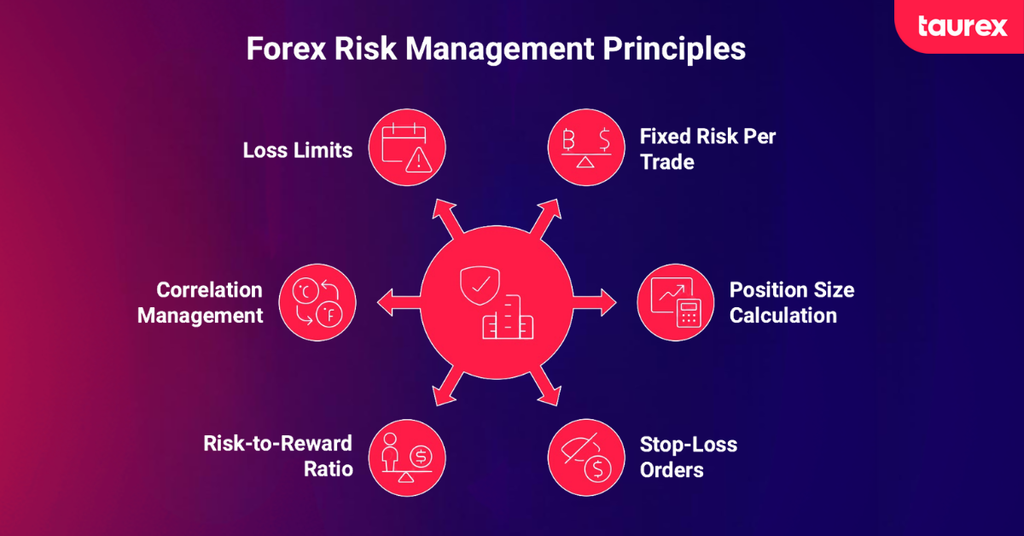
Six Core Forex Risk Management Principles
Individual tools work best within a consistent account-level plan.
1. Define a Risk Budget for Each Trade
A percentage-based budget connects planned risk to current account equity.
Planned cash risk = Account equity × Chosen risk percentage
For a $10,000 account, an illustrative 1% budget equals $100. If equity falls to $9,000, the same percentage equals $90.
This adjustment reduces the cash amount placed at risk as equity declines.
The often-mentioned 1% or 2% guidelines are not universally suitable. The appropriate budget depends on financial circumstances, strategy performance, simultaneous positions and tolerance for drawdowns.
2. Calculate Position Size Before Entry
Position sizing converts a cash risk budget into the quantity traded.
Position size = Cash risk budget ÷ (Stop distance in pips × Pip value per lot)
The pip value must be expressed in the account currency, and the result uses the same lot unit as the pip-value input.
Position-Sizing Example
Assume:
| Input | Value |
|---|---|
| Account equity | $10,000 |
| Planned risk percentage | 1% |
| Cash risk budget | $100 |
| Currency pair | GBP/USD |
| Account currency | USD |
| Stop distance | 50 pips |
| Pip value per mini lot | $1 |
The calculation is:
$100 ÷ (50 × $1) = 2 mini lots
Two mini lots equal 0.20 standard lots for a conventional 100,000-unit standard contract.
At $2 per pip, a 50-pip adverse move produces a $100 price loss if execution occurs at the assumed exit. Commissions and adverse fills can increase that amount.
Choose the stop location first, then calculate the size that fits it.

3. Use Stop-Loss Orders With Clear Rules
A stop-loss creates an exit trigger when the market moves against a position. Its placement should follow the strategy rather than an arbitrary amount of discomfort.
Possible methods include:
- Fixed-distance stops: A specified number of pips from entry.
- Structure-based stops: Levels beyond a relevant swing, support or resistance area.
- Volatility-based stops: Distances informed by measures such as Average True Range.
- Trailing stops: Stops that adjust after favorable price movement under defined settings.
These methods serve different purposes. A volatility-based stop, for example, is a placement method; it does not provide guaranteed execution.
Understand What a Stop Cannot Guarantee
A standard stop can fill beyond its trigger during a gap or rapid move.
A trailing stop moved to the entry price also does not necessarily secure an all-in break-even result. Commissions, financing and execution differences may still produce a loss.
Widening a stop increases planned cash risk if position size stays unchanged. Any adjustment needs a fresh calculation.
4. Evaluate Risk-to-Reward Alongside Actual Results
Risk-to-reward compares the planned loss with the target profit.
Risking $100 to target $200 creates a 1:2 ratio. However, the target must be reached often enough for the strategy to work after costs.
| Risk-to-reward ratio | Theoretical break-even win rate before costs |
|---|---|
| 1:1 | 50% |
| 1:2 | 33.33% |
| 1:3 | 25% |
There is no ratio that automatically makes a strategy profitable.
Review actual average wins, actual average losses and trading expenses. A planned 1:2 strategy can perform very differently if profitable trades close early or losses exceed their intended exits.
5. Check Correlated Currency Exposure
Several positions can express the same underlying view.
Buying EUR/USD and GBP/USD means selling US dollars against two currencies. Broad dollar strength may therefore hurt both trades.
Similarly, buying EUR/USD and selling USD/CHF both create exposure to dollar weakness, despite the different buy and sell instructions.
Historical correlations help assess relationships, but precise coefficients depend on the data period and timeframe. They should not be treated as permanent facts.
Before opening another trade, review the currencies bought and sold, position sizes and combined planned losses.
6. Set Daily and Weekly Review Limits
A loss threshold gives you a predefined point to stop opening trades and assess what is happening.
For illustration, a trader might use a $500 daily threshold on a $25,000 account. That equals 2% of starting equity, but it is an example rather than a recommended allocation.
The plan should specify:
- Whether the threshold includes unrealized losses.
- How existing positions are handled.
- When trading may resume.
- What must be reviewed before restarting.
A stopping rule can reduce impulsive trading. It cannot guarantee that gaps or execution problems will keep losses below the threshold.
Practical Forex Risk Management Example
Consider a hypothetical AUD/USD trade using an account denominated in Australian dollars.
| Parameter | Assumption |
|---|---|
| Account equity | AU$10,000 |
| Illustrative risk budget | 2%, or AU$200 |
| AUD/USD entry rate | 0.7250 |
| Position size | 50,000 AUD |
| USD pip value | US$5 |
| Proposed stop distance | 29 pips |
| Proposed target distance | 87 pips |
At the entry exchange rate:
AU$200 × 0.7250 = US$145
For a 50,000-unit AUD/USD position:
50,000 × 0.0001 = US$5 per pip
A 29-pip stop therefore represents:
29 × US$5 = US$145 of price risk
An 87-pip target represents US$435, creating a planned 1:3 risk-to-reward ratio.
Account for Currency Conversion
The AU$200 figure is approximate because a USD-denominated trading loss may be converted back into AUD at a different exchange rate when the position closes.
For example, if a long position exits exactly 29 pips below 0.7250, the exit rate is 0.7221. Converting the US$145 loss at that rate gives approximately AU$200.80, before other costs.
At a hypothetical 1% margin requirement, the position would require approximately AU$500 in margin. Its effective leverage against the full AU$10,000 account is approximately 5:1.
This example shows why margin, effective leverage and planned loss need separate calculations.
Tools for Managing Forex Risk
The most useful tools make exposure easier to calculate and review.
| Tool | Main purpose | Important check |
|---|---|---|
| Position-size calculator | Converts a risk budget and stop distance into quantity | Correct contract size and account currency |
| Pip-value calculator | Measures the account impact of a pip | Relevant conversion rate |
| Economic calendar | Identifies scheduled releases | Correct time zone and event timing |
| Risk-to-reward drawing tool | Displays planned entry, stop and target | Costs and actual execution assumptions |
| ATR indicator | Measures recent price movement | Historical movement does not predict the next move |
| Correlation matrix | Shows historical relationships between pairs | Measurement period and changing relationships |
| Margin monitor | Tracks equity and available margin | Broker-specific closeout rules |
| Trading journal | Compares planned decisions with actual results | Complete costs, fills and rule compliance |
Trading platforms may provide some features directly and others through broker tools or add-ons. Verify what is available in your setup.
Automated risk controls also need supervision. A system that pauses trading at a threshold can still be affected by connection failures, incorrect settings or execution delays.
Common Forex Risk Management Mistakes
Risking Too Much During a Losing Streak
Large position sizes make consecutive losses more damaging.
If you lose exactly 10% of remaining equity on each of ten trades, approximately 34.9% of the starting equity remains, before costs. The account is not mathematically wiped out, but the drawdown is severe.
Percentage risk applies to a changing equity base. Claims that a fixed number of losses automatically exhausts an account often overlook this distinction.
Moving Stops to Avoid Accepting a Loss
Giving a trade more room increases exposure when position size remains unchanged. Repeated adjustments can turn a defined risk into an open-ended decision.
Confusing More Trades With Diversification
Several pairs can share the same currency exposure. Review the combined position rather than counting the number of instruments.
Ignoring Trading Costs
Spreads, commissions and financing reduce net returns. They are particularly important for frequent trading and extended holding periods.
Trading to Recover a Specific Amount
A previous loss does not improve the next opportunity. Increasing size to recover money can push exposure beyond the account’s rules.
Practising a Consistent Risk Management Routine
A demo account can help you practise calculations, order placement and exposure monitoring without committing real trading capital.
Use realistic equity and position sizes. Record planned risk, actual fills and any changes made during a trade.
Demo conditions can differ from live execution, and simulated trading does not reproduce the emotional pressure of real losses. Its value lies in practising the process and identifying operational mistakes.
Frequently Asked Questions
What Are the Biggest Risks in Forex Trading?
Important risks include adverse price movements, excessive leverage, poor liquidity, unexpected events and changes in interest rates or financing costs. Several can affect one position simultaneously.
What Percentage Is Safe to Risk Per Trade?
No percentage makes a trade safe. Figures such as 1% and 2% are planning guidelines, not guarantees. Assess the budget alongside total exposure, possible losing streaks and personal financial circumstances.
What Is the Difference Between Margin and Risk?
Margin is collateral required by the broker. Planned risk estimates the loss associated with a position and intended exit. Neither the margin requirement nor a standard stop guarantees the maximum possible loss.
What Is the Best Forex Risk Management Strategy?
A practical framework combines a defined cash risk budget, calculated position size, planned exits, leverage controls and account-level loss rules. Its effectiveness depends on consistent application and a sound underlying strategy.
Is a 1:2 Risk-to-Reward Ratio Always Better?
No. A larger target may be reached less frequently. Profitability depends on actual win rates, realized wins and losses, and total costs.
Can Risk Management Guarantee Profits?
No. It helps make exposure deliberate and measurable. It cannot eliminate trading losses or create a reliable advantage where none exists.
Risk notice: Leveraged forex and CFD trading can cause substantial losses. This article is educational, and its examples are not personalized investment recommendations.