
SEO title: Indonesia MSCI Exclusion Risk Sparks Market Sell-Off
Focus keyword: Indonesia MSCI exclusion
URL slug: indonesia-msci-exclusion-risk
Meta description: Indonesia faces possible MSCI exclusion, raising concerns over foreign outflows, rupiah weakness and financing costs as authorities pursue market reforms.
Indonesia Faces MSCI Exclusion Risk as Investors Assess Capital Outflows
Indonesia faces a potentially damaging change in its relationship with international investors after MSCI proposed moving its equity market from emerging-market classification to standalone status.
The proposal goes further than the frontier-market downgrade previously considered. It could remove Indonesian shares from widely followed international benchmarks, prompting selling by funds whose investment mandates depend on index membership.
No final reclassification decision has been made. MSCI is accepting consultation feedback until April 30, 2027, and plans to announce its decision by June 30, 2027. MSCI Inc.
For Southeast Asia’s largest economy, the immediate concern is potential equity outflows. The broader risk is that weaker investor confidence spreads to the currency, borrowing costs and corporate financing.
Why MSCI Is Considering Reclassifying Indonesia
MSCI’s concerns center on whether international institutions can reliably assess ownership, available shares and market prices.
The index provider cited persistent ownership opacity, suspected coordinated trading and insufficient evidence of effective enforcement. These concerns affect its assessment of whether Indonesian equities remain suitable for emerging-market benchmarks. MSCI Inc.
Why Free Float Matters
Free float generally refers to the portion of a company’s shares available for public trading, rather than holdings considered strategic or otherwise restricted.
For investors, an accurate estimate helps establish how readily a stock can be bought or sold.
If ownership relationships are unclear, the apparent supply of tradable shares may differ from what investors can realistically access. That can complicate index construction, liquidity assessments and portfolio management.
The issue is therefore broader than disclosure paperwork. It concerns confidence in how the market functions.
Standalone Status Would Carry Greater Consequences Than a Frontier Downgrade
Indonesia has held MSCI emerging-market status since 1989, making the proposed change a significant reversal.
A move to frontier classification could attract some demand from funds tracking frontier-market indexes, even as emerging-market funds reduce their holdings.
Standalone status would not provide that same automatic destination for investment.
Exclusion Would Not Ban All Foreign Investment
Removal from major benchmarks would not legally prevent every international investor from buying Indonesian shares.
Some active funds and specialist investors could retain exposure, depending on their mandates and assessment of conditions.
However, index membership provides an important route into institutional portfolios. Losing that position could narrow the investor base and make attracting capital more difficult.
The distinction matters: the proposal threatens an important investment channel, rather than automatically closing every source of foreign financing.
Indonesian Shares Fall Sharply After the Announcement
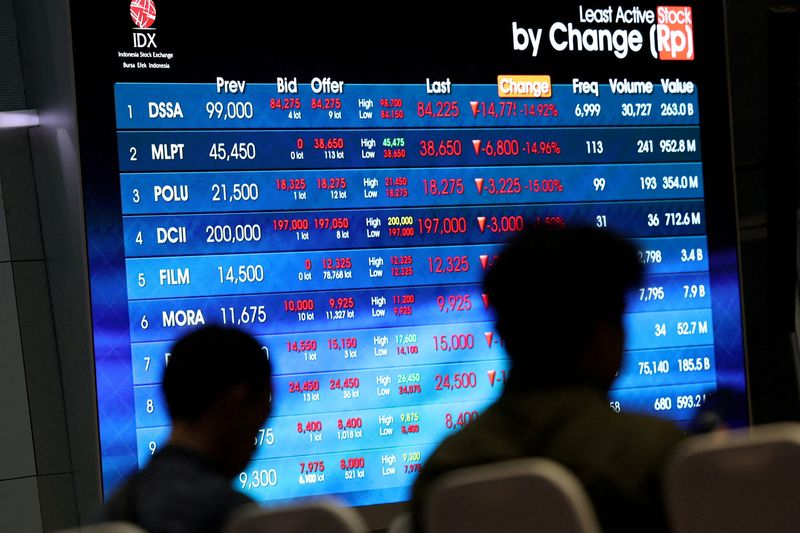
According to the supplied Reuters report, the Jakarta Composite Index fell approximately 11.6%, its largest one-day decline since the Asian financial crisis in 1998.
The sell-off erased about $65 billion in equity market value.
That decline reflects a repricing of listed shares. It should not be confused with an equivalent amount of cash leaving the country.
Investors were responding both to possible future fund selling and to uncertainty over how long it might take to restore confidence.
The Rupiah Also Comes Under Pressure
The rupiah weakened as much as 0.8%, extending the reaction beyond equities.
Currency pressure can develop when foreign investors sell domestic assets and convert the proceeds into other currencies. Concerns about further depreciation may also influence investors who have not yet sold.
The eventual impact depends on actual flows, domestic demand for assets and the policy response.
How Much Foreign Investment Could Leave?
Banks cited in the supplied report estimated that reclassification could trigger $3 billion to $6 billion in passive outflows.
JPMorgan estimated approximately $4.8 billion, while UBS warned that active investors could withdraw a further $15 billion.
| Estimate cited in the report | Potential outflow |
|---|---|
| Passive fund estimates across banks | $3 billion–$6 billion |
| JPMorgan passive estimate | $4.8 billion |
| UBS estimate of additional active withdrawals | $15 billion |
These figures describe potential outcomes, not completed withdrawals or guaranteed future losses.
Passive and Active Funds Face Different Decisions
Passive funds generally seek to replicate an index. If Indonesian securities become ineligible for their benchmark, those funds may need to reduce or eliminate exposure.
Active managers have more discretion, but their decisions can still be constrained by investment mandates, liquidity requirements and client expectations.
The estimates should therefore not be treated as one certain combined total. Actual selling would depend on the final decision, implementation arrangements and investor positioning.
Indonesia’s Remaining Index Weight Still Matters
Indonesia’s share of MSCI’s emerging-market benchmark has already declined.
JPMorgan figures cited in the report put its weight at approximately 0.46%, compared with 1.2% at the end of 2025.
Although that appears small, a modest percentage of a large investment pool can represent substantial exposure.
The report noted that more than $1.8 trillion in assets were benchmarked to MSCI emerging-market indexes. Benchmarking does not mean every dollar is managed passively, but it illustrates the scale of portfolios influenced by the classification.
Could Equity Outflows Spread to Bonds?
A major concern is whether the initial equity shock leads investors to reassess other Indonesian assets.
Citi analysts raised the possibility of a pre-emptive central bank rate increase to limit the risk of equity outflows spreading into fixed income or being reinforced by domestic capital movements.
Higher Rates Would Involve a Trade-Off
Higher interest rates could help support demand for rupiah assets.
They could also raise borrowing costs for companies and households, adding pressure to investment and economic activity.
The supplied report described a possible rate increase as an analyst scenario. It was not an announced central bank decision.
Corporate Financing and Public Spending Could Be Affected
The consequences could extend beyond share prices if Indonesian businesses face a smaller investor base or a higher cost of capital.
State-linked companies are particularly relevant because financing difficulties could affect projects connected with government priorities.
Citi analysts suggested that more expensive or restricted fundraising could force some spending back onto the government’s balance sheet or lead to reduced investment.
The Economic Impact Would Be Indirect
An index decision does not immediately stop production, exports or domestic consumption.
Its influence would operate through financial conditions: investor confidence, currency movements, access to funding and the return investors demand.
That makes the scale of the eventual economic effect uncertain. Much depends on whether market disruption proves temporary or develops into a sustained financing problem.
Authorities Face Pressure to Demonstrate Reform
Indonesia has announced measures intended to improve transparency and market functioning.
MSCI’s June review acknowledged enhanced shareholder disclosures, more detailed investor classifications, a framework for identifying concentrated shareholdings and a roadmap toward a 15% minimum free-float requirement. It emphasized the importance of consistent implementation and sustained results. MSCI Inc.
The supplied report also said regulators announced sanctions linked to alleged manipulation in three stocks.
Announcements Alone May Not Resolve Investor Concerns
The central challenge is demonstrating that reforms change conditions across the market.
More accessible ownership information, credible enforcement and reliable assessments of tradable shares could help address the concerns. However, investors will judge the practical effects, rather than the existence of new rules alone.
A Rare Classification Change With Different Historical Causes
The supplied report compared the proposal with earlier removals involving Argentina and Russia.
Argentina’s case involved capital controls, while Russia’s followed sanctions and severe restrictions on market access after its invasion of Ukraine.
Those precedents demonstrate the unusual nature of standalone classification. They do not mean Indonesia faces identical economic conditions or that its markets would follow the same path.
Indonesia’s case centers on ownership transparency, trading behavior and confidence in enforcement.
What Investors Will Watch Next
The consultation leaves time for authorities to demonstrate improvements and for investors to submit evidence.
The most important developments will include:
- Clearer information about share ownership and control.
- Evidence of effective action against market misconduct.
- More reliable free-float assessments.
- Foreign equity and bond flows.
- Rupiah movements and the monetary-policy response.
- Further guidance on any reclassification timetable.
Indonesia’s position now depends on more than responding to a sharp sell-off. Authorities need to show that announced reforms produce durable improvements in how the market operates.